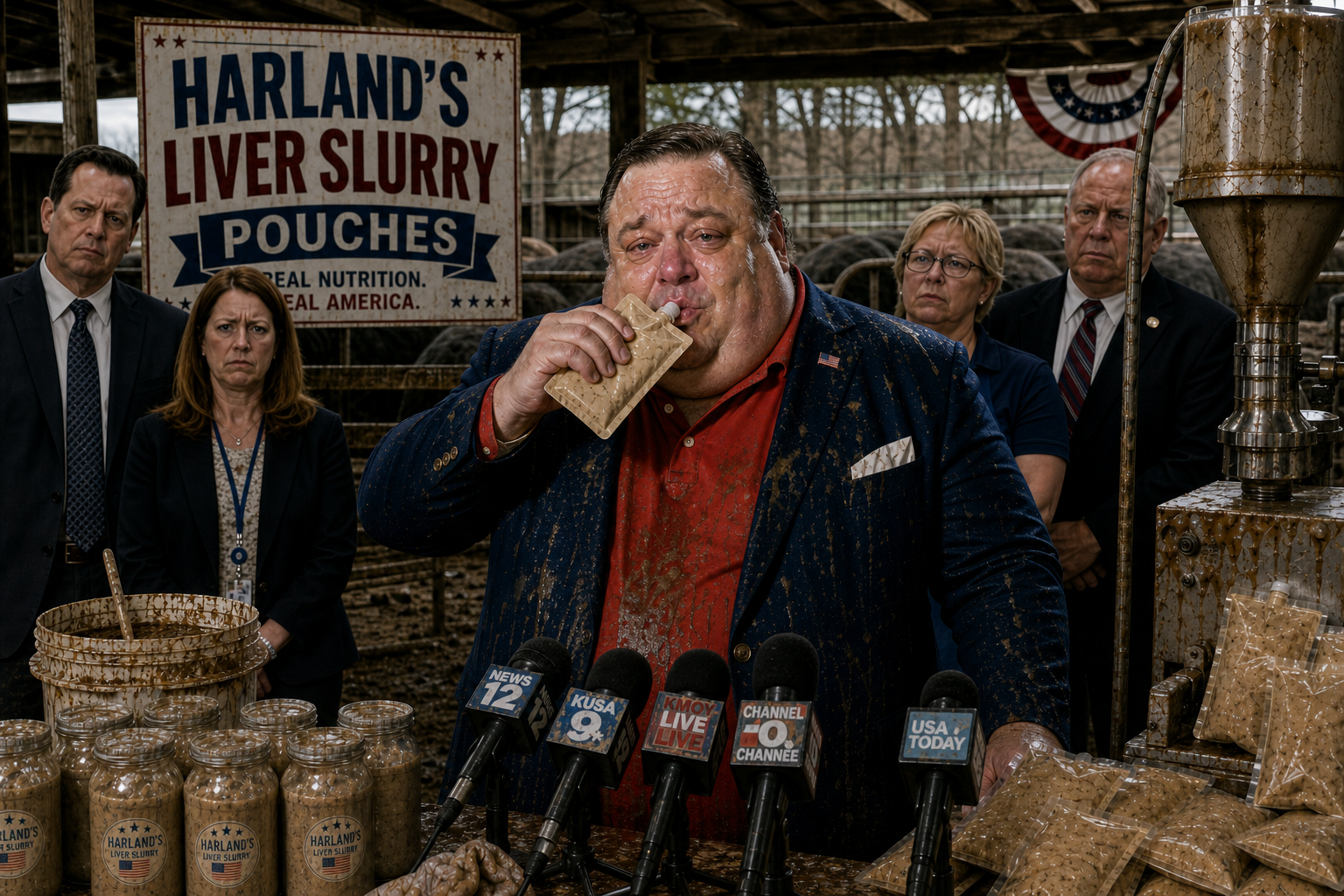
LITTLE ROCK, Ark. — Arkansas Secretary of Health candidate Harland Griggs held a press event this week inside the sweltering back room of his liver slurry processing facility to demand that every public school in the state serve Harland’s Liver Slurry Pouches as a mandatory daily cafeteria beverage option.
Griggs stood beneath a sign reading “Make Arkansas Healthy Again,” its lower edge crowded with flies. His navy blazer and red shirt were crusted with dried brownish-green slurry in some places and streaked with fresher smears in others, some of it still wet enough to shine when he gestured. Sweat poured down his flushed face before he even opened his mouth, soaking his collar until it clung translucent to his skin. Behind him, campaign aides shifted uncomfortably in a shallow smear of cow manure near the holding pens, an open five-gallon bucket of room-temperature slurry with a few innard-speckled bubbles rising to the surface, and a dented metal pouching machine caked with weeks-old residue along the seams.
“Secretary Kennedy is right,” Griggs declared, his voice thick and enthusiastic. “For years, children have been told health comes in sugary little drinks and shiny fruit pouches, full of dyes that turn their tongues blue. The MAHA movement is reminding us to get back to organ meats — the cheapest, most nutrient-packed parts of the animal, the parts our grandparents ate without apology. RFK reminded us liver is real food. It’s not fancy. It’s not elite. The answer has been inside the animal the whole time, and schools have just been throwing it away.”
The proposal would force every Arkansas public school cafeteria to display Harland’s Liver Slurry Pouches right next to the milk, juice, and water during breakfast and lunch. Students wouldn’t technically be forced to drink one, Griggs emphasized, but the pouches would sit at eye level so no child could possibly avoid them.
He described the product as a shelf-stable “organ beverage” packed with “the old nutrition, in a new fun form.” While speaking, Griggs grabbed a soft beige pouch, squeezed hard, and produced a wet gurgling sound. A thick, lukewarm rope of slurry finally oozed into his mouth. Some escaped down his chin and clung there in a glistening strand. He left it for several seconds, savoring the moment.
The pouches would come in three kid-friendly flavors: Straight Liver Render, Berry Beef Blast, and Choco-Liver Swirl.
When asked if the product had been reviewed by nutrition experts, Griggs was dismissive. “I don’t need a person with a degree to explain liver to me,” he said. “I drink at least two every day, and look at me. This is what happens when a man listens to his body instead of a chart.”
On refrigeration, Griggs waved the concern away with a slurry-stained hand. “People have gotten too nervous about temperature,” he said. “Food existed before refrigerators. The body knows the difference between danger and nourishment.”
Some school officials in attendance looked unconvinced. One district food-service director began saying any new item would require the normal approval process when Griggs cut her off.
“Save it,” Griggs snapped. “Look at you — pale, doughy, and half-dead from all that sugar slop. That is what avoiding real organ meat does.”
A reporter asked whether the state had any business putting a warm organ pouch in front of children at lunch, especially one produced in the facility behind him.
Griggs turned from the microphones and stared her down as he finished the pouch. He did not answer. The room stayed tense for several moments, quiet except for the sound of him squeezing the last of the slurry into his mouth.
Near the end of the event, Griggs demonstrated his preferred production method by stepping into one of the cattle pens. He selected a wide-eyed brown cow that was still shifting nervously, pinned it against the railing with his knee, and made a deep, wet incision along its flank while explaining that only a liver taken while the heart is still beating truly preserves the “living vital force” and raw enzymes. The animal let out a long, guttural bellow that echoed through the facility, followed by panicked snorts and wet wheezing as Griggs reached elbow-deep inside the thrashing cow. With both hands he wrestled out a massive, steaming, purple-red section of liver still pulsing faintly. Thick ropes of blood and warm fluids poured down his forearms and onto the concrete as he squeezed the quivering organ directly into a clear pouch. He held the dripping, sagging pouch high for the cameras, slurry and blood running off his elbows.
Griggs enthusiastically offered the just-filled pouches to the attending school officials to end the conference. None were accepted.